
To make an AI fruit drama video, you cast two to four fruit characters with human faces, write a short soap-opera scene, give each fruit its own voice, and have every line acted out on camera, lip-synced. In ClipFlux that is a Talking character video with a conversation cast: each line becomes a close-up of the fruit saying it, and the video cuts between them like a TV drama, in 9:16 for TikTok, YouTube Shorts and Reels.
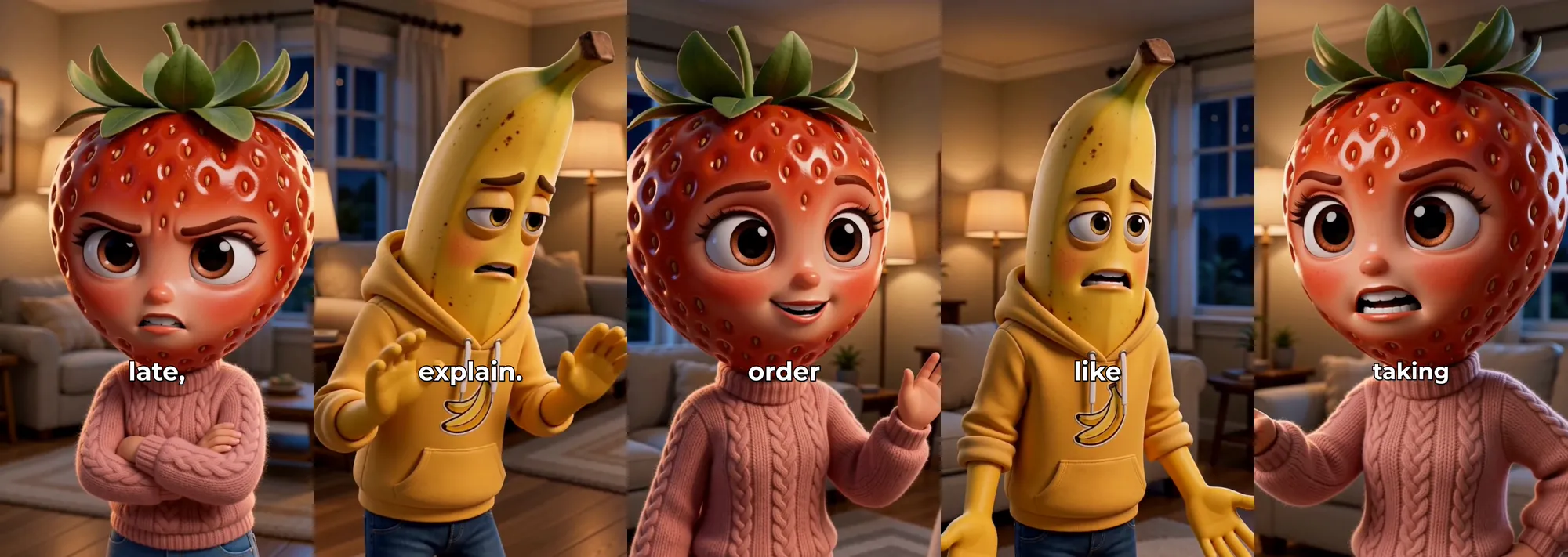
AI fruit drama in ClipFlux, in short
- Up to 4 fruit characters in one scene, each with its own face and voice.
- Every line is acted out on camera by the fruit who says it, lip-synced.
- The scene cuts between speakers like a TV drama, each turned toward the other, not the viewer.
- Your script word for word, up to 150 words (about a minute), with a line editor that keeps track of who says what.
- Captions timed to each spoken line.
- The same cast every episode, by hand or on a daily channel.
What the fruit drama trend is
Fruit drama videos, often called Fruit Love Island after the reality show they parody, are short AI clips in which fruit with human faces and bodies act out romance, cheating, pregnancy reveals and family feuds. They work for the same reason any soap opera works: a betrayal and a reveal in under a minute. The fruit just make it absurd enough to share. The look is glossy 3D animation with warm, dramatic light, and every character speaks on camera.
You do not need a 3D artist or an animation tool for it. What you need is a cast that looks the same in every shot, a voice per character, and lines that land.
Step 1: Cast two to four fruit characters
Make each fruit a character in ClipFlux: a picture that decides its face in every clip. Describe a fruit head on a human body with one clear outfit, so the viewer tells them apart in a single frame. A strawberry head in a pink jumper. A banana in a yellow hoodie. A mango in a red dress. The Storybook 3D style gives the glossy animated look; the fruit comes from the pictures you make.
Two characters is the easiest scene to follow. Three gives you a love triangle. Four is the most a scene can hold.
Step 2: Write a soap-opera scene
Write one line per turn, each starting with the fruit’s name and a colon. The names are labels and are never spoken. Here is the scene behind the frames above, six lines and about 25 seconds:
Strawberita: You told me you were working late. So why does your hoodie smell like Mango?
Banana: Babe, I can explain. Mango was just helping me with a smoothie order.
Strawberita: A smoothie order. At two in the morning. In her kitchen.
Banana: Okay, when you say it like that, it sounds really bad.
Strawberita: Pack your peel and get out. And you are not taking the kids.
Banana: Funny you mention the kids. The DNA test came back this morning.
What makes it work:
- Open mid-argument. The first line is already an accusation. No introductions.
- A reveal every line or two. Late at work, then the smell, then two in the morning, then her kitchen.
- One fruit pun per scene, not one per line. “Pack your peel” lands because it is the only one.
- End on a twist, not a resolution. The DNA test is the cliffhanger that makes people want part two.
In ClipFlux you can type the lines in that form, or use the line editor: add the cast once, then each Enter starts the next fruit’s line.
Step 3: Give each fruit its own voice
Pick a different voice for every character and play the previews side by side. Drama needs contrast: a sharp, clipped voice for the one who is angry, a softer, hesitant one for the one with something to hide. When the voices differ, the viewer knows who is talking before the cut even happens.
Step 4: Generate the scene
ClipFlux records every line in its character’s voice, then makes a close-up of that fruit performing it: the mouth in time with the words, the face reacting, the body turned toward whoever they are arguing with. The video cuts from one speaker to the next, the way TV cuts a conversation, and the captions are timed from each clip.
Watch it through once. If a line came out in the wrong face, or the mouth slipped, regenerate only that line. More on how a two-person scene is framed in how to make two characters talk to each other.
Step 5: Keep the cast for the next episode
The accounts that grow on this trend run a series: the same cast, the same living room, “Part 2” in the caption, and a cliffhanger at the end of each one. Your characters are saved, so the next episode is just a new scene. To post one every day on a paid plan, set up a ClipFlux channel with Talking character as its format and the fruit as its conversation cast; it writes a new scene between them from each day’s idea, one sentence of plot like “Strawberita finds out Banana was at Mango’s at 2am”. See how to automate TikTok videos.
Post with the platform’s AI-generated label on. And keep the cast your own: invent your fruit and their names rather than copying another account’s characters, which also makes your series the one people search for.
More talking character videos
- How to make AI talking character videos: the full guide to the format, for one character or a whole cast.
- The talking pigeon: one character, a deep voice, a reminder straight to camera.
- Consistent characters in AI videos: how a character keeps the same face from shot to shot.
Questions
What is the Fruit Love Island trend?
A wave of AI videos on TikTok in which fruit characters with human faces act out reality-show romance and betrayal. ClipFlux is not affiliated with any creator of it; this guide shows how to make your own fruit drama in that style.
Which look gives the glossy 3D fruit?
A Pixar-like 3D animated look with warm, cinematic light. In ClipFlux that is the Storybook 3D style; the fruit itself comes from the character pictures you make.
How many fruits can be in one scene?
Up to 4, each with its own character and voice. Two or three keeps a short scene easy to follow.
Can a fruit drama channel post every day by itself?
Yes, on a paid plan. A ClipFlux channel with a conversation cast writes a new scene between the same fruits from each day's idea and makes it on a schedule.