
To make faceless YouTube Shorts with AI, you pick a niche and a visual style, then use an AI video generator to produce the whole video from a topic: it writes the script, generates a scene for each beat, adds an AI voiceover and speech-synced captions, and exports a 1080p vertical video ready to upload. In ClipFlux you type the topic, pick one of its looks and a voice, check the scenes one by one, and post the Short to YouTube straight from the app. No camera, no face, no editing timeline. The craft moves from editing to two places: choosing topics people want to watch, and reviewing the generated scenes before you publish.
Why faceless works on Shorts specifically
Shorts is a feed of anonymous, format-driven videos where the hook and the story carry everything; nobody expects a host. That makes it the one YouTube surface where an AI-generated channel competes on even footing with filmed content. It is also repeatable: a faceless format is a template you can run every day, which is what the Shorts algorithm rewards.
Step 1: Pick a niche with a story engine
The channels that survive have a niche that generates infinite concrete topics. Test your idea against this: can you write 30 specific video premises in 20 minutes? Good examples:
- POV history: "POV: you are a plague doctor in 1348", one era per video, endless supply.
- What-if scenarios: "What if the Library of Alexandria never burned?"
- Ranked facts: "3 animals that survived things that should be impossible."
- First-person horror or diary stories, the format behind the viral skeleton POV videos.
Avoid niches where being wrong has consequences (medical, legal, financial advice). AI scripts need fact-checking anywhere, but in those niches an error costs you the channel.
Step 2: Lock one visual style
A faceless channel is recognized by its look. Pick one style (cinematic realism, dark animation, retro illustration) and keep it for every video. Consistency does double duty: viewers recognize you in the feed, and YouTube's systems get a clean signal about what your channel is. In ClipFlux you pick the style once as part of the template and every scene in every video inherits it.
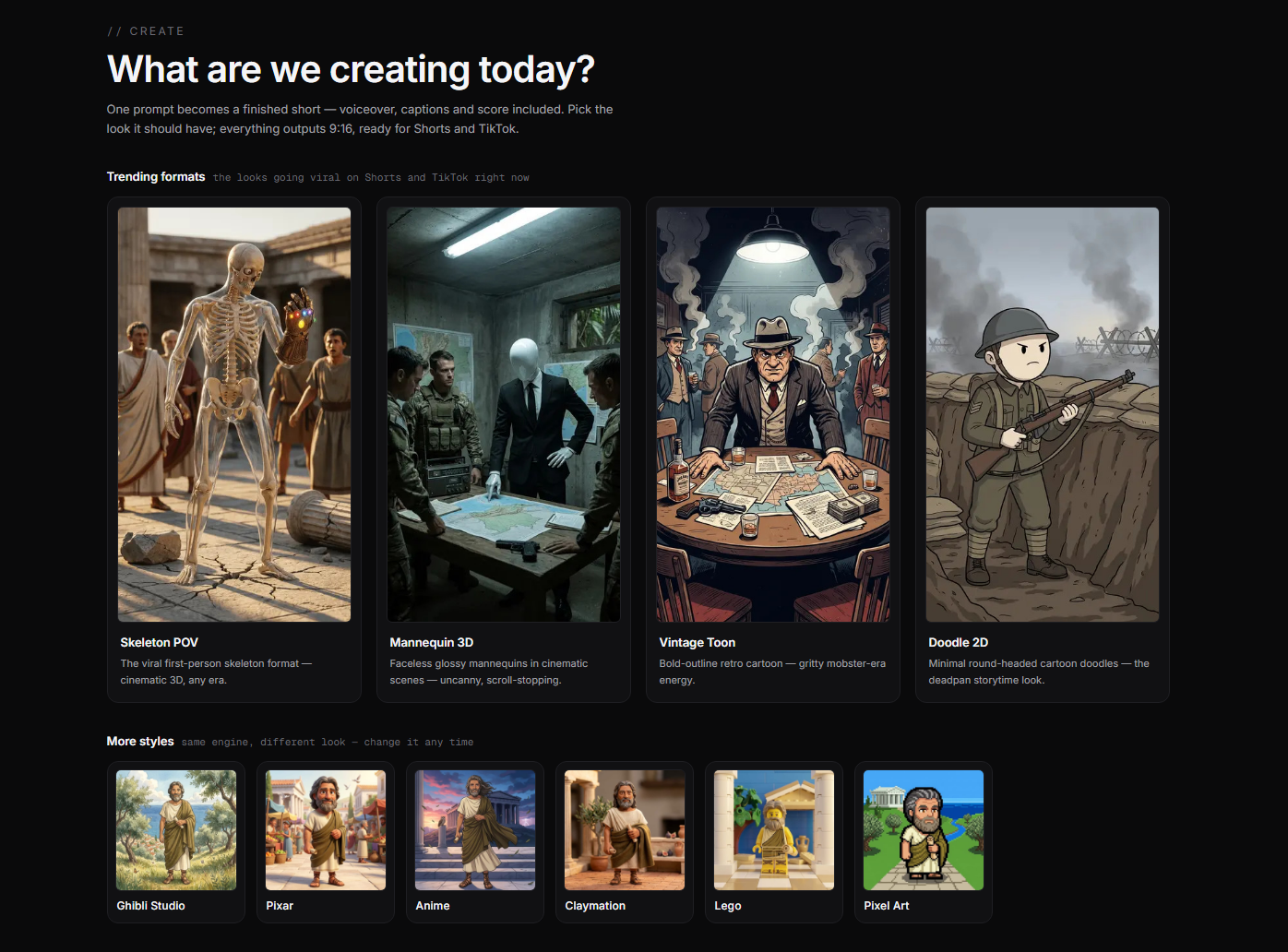
Step 3: Generate, then actually review
The generation itself is the easy part: type the topic, pick the voice, wait a few minutes. The step that separates good channels from AI slop is scene review. Watch every scene and ask: does the visual match the line being narrated, is the character consistent with the previous scene, is there a mangled detail? In ClipFlux you regenerate any single scene with a written note about what to change, so fixing one bad frame does not mean rerolling the whole video. Budget five minutes of review per video; it is the highest leverage five minutes in the workflow.
Step 4: Captions, voice and length
- Captions are not optional. A large share of Shorts viewers watch muted or half-muted. Word-synced captions are the floor, and every serious tool generates them automatically.
- Pick one voice and keep it. The voice is your host. Changing voices between videos resets the familiarity you are building.
- 30 to 45 seconds is the working range for story formats: long enough for an arc, short enough that completion rate (the metric Shorts optimizes hardest for) stays high.
Can faceless AI Shorts be monetized?
Yes, and this is where most guides hand-wave. YouTube's monetization policies do not ban AI-generated content; they ban reused and mass-produced content without original value. The practical line: a channel that generates original stories, with its own scripts, visuals and narration, is original content even though AI produced it. A channel that scrapes Reddit posts over stock gameplay, or republishes the same template output as a hundred near-identical videos, is what the policy exists to catch. To stay clearly on the right side:
- Write or meaningfully edit your topic premises yourself.
- Review and fix scenes rather than bulk-publishing raw output.
- Use YouTube's altered-content disclosure for realistic AI-generated material when you upload.
Requirements for the YouTube Partner Program itself (subscriber and view thresholds) are the same for faceless channels as for anyone else, and Shorts revenue comes from the Shorts ad revenue pool. Many faceless channels earn more from affiliate links and sponsorships than from ads; the channel is the asset either way.
Common mistakes
- Publishing raw output. One garbled scene per video reads as a broken channel after ten videos.
- Niche hopping. Five niches on one channel means the algorithm cannot find your audience. One channel, one niche.
- Quitting at video 15. Shorts channels typically look dead for weeks and then a video breaks out. The economics of AI generation mean 60 videos costs less than one camera, so consistency is cheap. Post daily and judge the niche at video 50, not video 10.
The workflow, end to end
Once set up, a daily faceless Shorts channel takes roughly 15 minutes a day: pick the next topic from your queue, generate, review the scenes, regenerate the one or two that miss, and either upload or let a scheduler post it. If you want the whole channel automated, a ClipFlux Channel picks the topic, makes the Short and posts it to YouTube on the days and at the hour you choose. Our guide to YouTube automation covers how to do that inside YouTube's rules: official integrations only, at most one video a day, and keep the human spot check.