
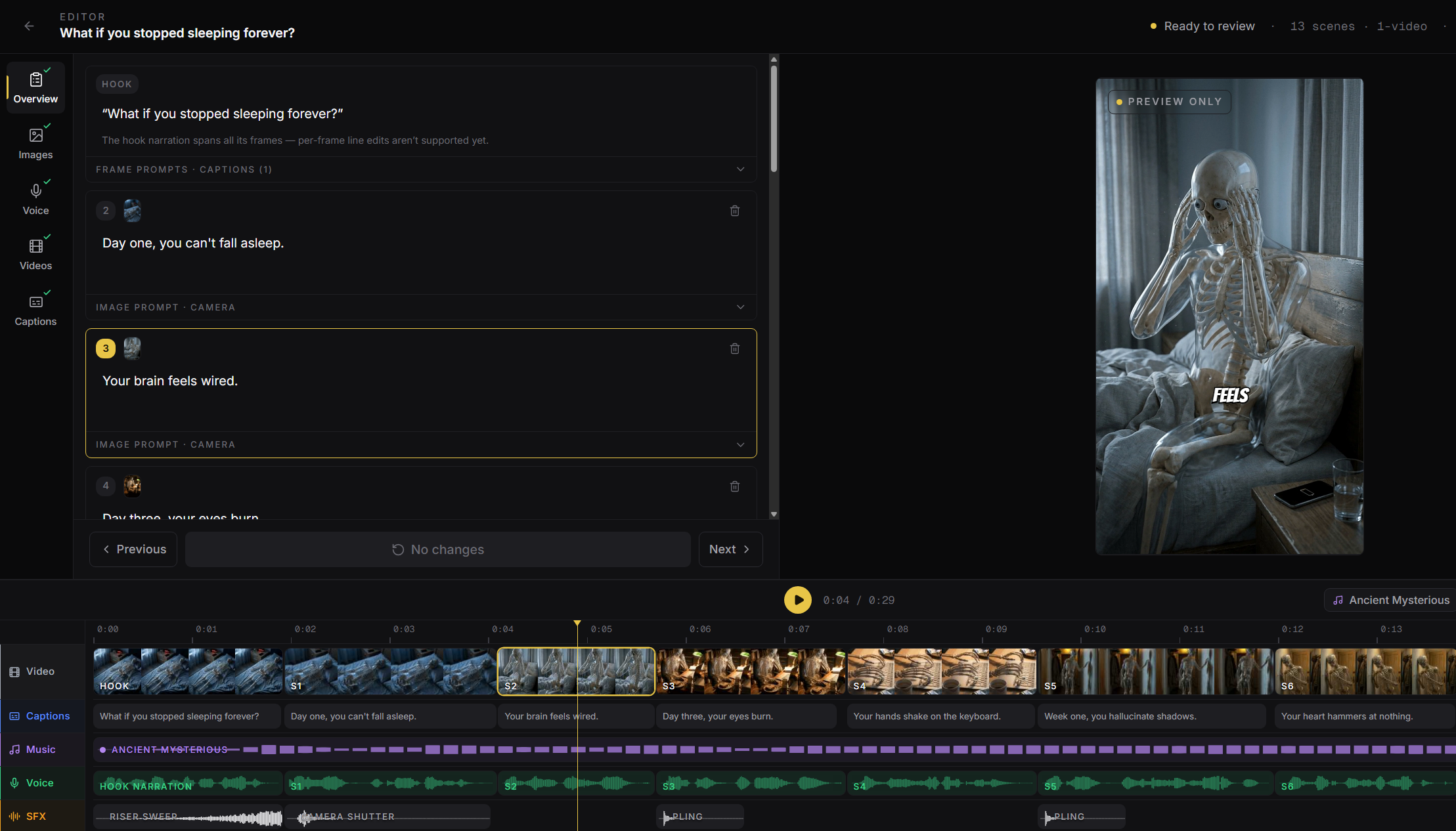
AI skeleton POV videos are made by generating a series of first-person scenes starring a skeleton character dropped into an unexpected time or situation ("POV: you are a skeleton working the night shift in Ancient Greece"), then narrating them as a diary over AI voiceover with synced captions. You can build one manually by prompting an image or video model scene by scene and assembling in an editor, or generate the whole thing from a single premise with a template tool like ClipFlux, whose first template is exactly this format. The hard part is not generation; it is keeping the same skeleton recognizable across every scene.
Why this format keeps going viral
The skeleton POV format works because it stacks three things the short-video feed rewards. The premise is instantly legible: one line of text on the first frame tells you the entire joke. The diary structure ("Day one... Day two...") is a built-in retention device, since every day-marker is a mini cliffhanger. And the skeleton itself is a blank, expressive everyman: it can be anywhere, in any era, doing any job, which means the format never runs out of premises. Viewers do not follow one video; they follow the series.
The anatomy of a good one
- The premise line (first 1 to 2 seconds). "POV: you are a skeleton and you just got hired as a Roman gladiator." Shown as text immediately; this is the hook and the thumbnail in one.
- The diary beats. 4 to 7 scenes, each one "day" or moment, narrated first person: "Day one. Nobody has noticed. The helmet helps." Deadpan works better than wacky; the skeleton is unbothered by things that should be alarming.
- The turn. Around scene 4 or 5, something escalates: discovery, promotion, an absurd complication.
- The punchline or cliffhanger. End on the strongest beat, or on "Day seven..." and cut, which feeds a part two.
Making it: the two routes
Route 1: Manual (image model + editor)
Prompt an image or video model for each scene, keeping a fixed character description in every prompt; generate a voiceover with a TTS tool; assemble in CapCut or an editor with captions and a trending sound. Expect an hour or more per video, most of it rerolling scenes where the skeleton came out with different proportions, wrong clothes, or extra fingers of bone. Character drift between scenes is the failure mode that makes videos read as sloppy, and fixing it prompt by prompt is the real cost of the manual route.
Route 2: Template (one premise in, one video out)
A template tool holds the format constant so you only supply the premise. In ClipFlux, the skeleton POV template takes your scenario, writes the diary-structured script, generates each scene with the same character identity, voices it and captions it. The scene review step matters most in this format: when one scene breaks character, you regenerate just that scene with a note like "same skeleton, but keep the centurion armor from scene 2," instead of rerolling the video and losing the four scenes that were already right.
Writing premises that hit
The formula is a mundane role in a non-mundane place, or the reverse. Strong pattern: skeleton + ordinary job + historical or fantastical setting. "Skeleton working at a medieval tavern" beats "skeleton in medieval times" because the job gives every diary beat a concrete scene: serving ale, dodging the cook, payday. Batch 20 premises at once; series momentum matters more than any single video, and part twos of premises that performed are the most reliable views you will get.
Posting it
- Post natively to TikTok, YouTube Shorts and Instagram Reels; the format performs on all three, and 9:16 1080p output works everywhere.
- Put the premise in the on-screen text and the caption. The caption is searchable; "POV" and the setting are what people search.
- Label AI-generated content where the platform provides the toggle. The format is obviously synthetic, which is part of its charm, so disclosure costs nothing.
- Run it as a daily series. A ClipFlux Channel can pick the next premise, make the video and post it to YouTube on a schedule; see what YouTube automation is and how to do it right; for the channel strategy around it, see faceless YouTube Shorts with AI.