
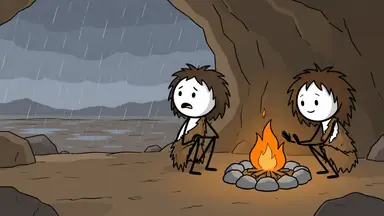
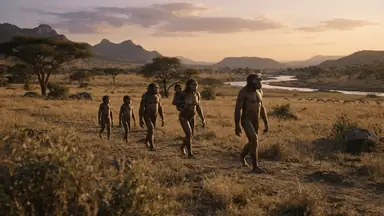

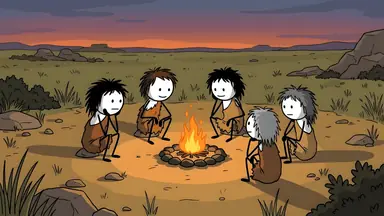
This 9:08 stick figure video was made with ClipFlux from one question and two lines of direction. ClipFlux wrote the script in 10 chapters, following "you" through a Stone Age day from waking in the cold before dawn to falling asleep by the fire, narrated it and drew all 89 scenes in its Cartoon Stickman look with the same family throughout. It is shown here unedited.
9:08, the whole video, unedited. Made with ClipFlux in the Cartoon Stickman look.
How it was made
| This video | |
|---|---|
| Started from | A written brief (below) |
| Look | Cartoon Stickman |
| Pacing | Standard: one picture a sentence |
| Length | 9:08 |
| Chapters | 10, after a cold open |
| Scenes | 89 |
| Edited by hand | No |
The full brief, as typed
What did ancient humans do all day? A calm, curious history explainer about a normal day for early humans in the Stone Age: waking at first light, finding water and food, making tools, looking after children, sharing stories by the fire at night. One question, answered in chapters, ending on what it means for us today.
What it gets wrong
- It follows "you" through the day, and "you" does a little too much: you go out hunting at dawn, yet you are also sharpening a spear point at the shelter "before the hunters leave" and looking after the children. Read as a whole group's day it works; read as one person's it does not quite add up.
- There are no dates or numbers in it, which is why it holds up: when an AI script names a year or a statistic, check it before you post. In ClipFlux any line can be sent back with a note and only that scene is made again.
- Captions are off, as they are by default on long videos; they can be switched on in the Studio before export.
Full transcript
0:00 Cold open
You wake before dawn. No alarm. No coffee. No choice. This is how your ancestors spent every single day for hundreds of thousands of years.
0:13 Before the sun rises
Your eyes open to near-total darkness, and your body knows why: the cold has crept into the shelter. Around you, others are beginning to stir: your family, your group, all waking to the same cold. No one speaks yet, but everyone listens: the first rule of survival is to know what waits outside. A bird calls from the cliff above: a sound you have heard a thousand times before, and it means safety. You stand, your joints stiff from the cold, and move toward the shelter's mouth to see what the day brings. The landscape is still mostly dark, but the eastern sky is beginning to pale, and you can see the valley below. No smoke from a rival group's fire, no movement in the brush, no sound of predators: the day is yours to begin. But before you hunt, before you gather, before you do anything else, your body demands one thing: water.
1:01 Finding water
The first thing your body needs is not food but water, and thirst pulls you from the shelter into the pale dawn light. You are not alone, and you do not go far without others, so you wait for your family to gather and prepare to move. You know where the water is because you have walked this path many times, but the land is never entirely safe or entirely familiar. You listen for danger as you walk, your ears tuned to sounds that mean predators or rival groups might be near. The sound of water grows louder as you approach, and your pace quickens because thirst is now the only thing that matters. You reach the stream and kneel at the edge, cupping water in your hands and drinking deeply until your thirst is finally satisfied. But drinking is only the first part of the task, because you must carry water back to the shelter for the rest of the group. You fill containers made from animal bladders or hollowed gourds, each one heavy with water, each one a necessity for survival. Water is life, and finding it is the first task that shapes your entire day, the foundation on which everything else depends. With water secured, you turn back toward the shelter, knowing that the next task is already waiting, and the day is far from over.
2:08 The hunt begins
The group gathers as light spreads across the grassland, deciding who will hunt and who will stay behind today. The choice is not yours alone: the season, the animals moving through the land, and who is needed at the shelter all decide. You decide to hunt today, moving out with two others across the grassland, reading the earth for signs of movement. You stop at a patch of soft earth and kneel, studying the tracks pressed into the ground before you. Hoofprints, still fresh, tell you that deer passed through here not long after dawn, moving toward the water. You rise and signal the others forward, moving quietly now, following the trail deeper into the scrub where prey often shelter. But not everyone hunts today: those who stayed behind move in a different direction, toward the places where roots grow and seeds ripen. A woman kneels at the base of a plant, using a sharpened stick to dig deep into the earth, loosening the root beneath. She pulls the root free, shakes the earth from it, and places it in her basket: food that will sustain the group for days. Both paths matter: the hunt may bring meat, but gathering feeds the group most days, and both require skill, patience, and knowledge.
3:14 Making and mending
You settle near the shelter entrance where light is strongest, stone tools spread before you on the ground. A spear point from yesterday's work has dulled at its edge, and it needs sharpening before the hunters leave. You pick up a smaller stone, one you have used a hundred times, and position it carefully against the point's edge. The strike is controlled, angled, timed by years of repetition until your hands know the motion without thinking. You strike again, and again, each blow removing a thin flake until the edge is sharp enough to cut skin. A child appears beside you, watching intently, and you do not stop or explain, simply continuing your work as they observe. The child reaches out slowly, and you hand them a hammerstone and a piece of bone, letting their hands try the motion. Their first strikes are clumsy, the angle wrong, the force uneven, but you watch without correcting, letting their hands learn. This is how knowledge moves from hand to hand, from one generation to the next, without words, without hurry, without end. By midday the spear point is ready, and a digging stick waits for a new bone point, and the work continues as it always has.
4:17 Caring for the young
By now the children are awake, hungry, and already underfoot in everything you do. You cannot leave them alone, so they come with you to the water source, splashing and playing. A child watches you scrape a hide and asks without words, reaching for the stone tool in your hand. You place the tool in their small hand and guide it, feeling them learn through touch and repetition. Later, a child follows you to the gathering place, learning which plants are safe to eat by tasting what you taste. A toddler stumbles and falls, and you pick them up without hesitation, checking for injury, offering comfort. You teach them to be human not through lessons but through living, through watching, through doing it together. This work never stops, never rests, and it is the only way a child becomes part of the group.
5:00 The hunters return
As the sun drops low, you hear voices calling from the tree line ahead of the camp. Three hunters step into the clearing, and you see immediately what the day has brought them. A large kill means meat for days, and you move quickly to help lower the carcass to the ground. But not every hunt ends like this, and you know the hunters' faces tell you which days brought nothing home. You begin the work that will take hours: the skin must come free, the meat must be cut from bone. Others work beside you, each hand knowing its task: one pulls the hide back, another cuts sinew free. The hide will become clothing or a water container, the bones will become tools and needles. Even the sinew becomes thread, and nothing that came from the animal is left to rot away unused. You understand this without being told: waste means hunger, and hunger means death in the cold months ahead. By the time the fire burns bright, the work is done, and the meat hangs in strips to dry and smoke.
5:54 Cooking and eating
The meat is cut into pieces and laid on hot stones near the fire's edge. The fat begins to sizzle and pop, and the smell spreads through the camp like a signal. Children stop playing and drift toward the fire, drawn by the smell before anyone calls them. Adults gather too, bringing roots they dug, berries they found, nuts they cracked open. There is no single meal time, no rush, no one eating alone in a corner. You eat what is here: meat, roots, berries, nuts, and sometimes insects if hunger demands it. Your diet changes with the seasons, with what the land offers, with what the hunters bring back. Hunger is always a shadow in the back of your mind, but tonight there is enough. And that is enough, because tomorrow will bring its own hunt, its own search, its own fire.
6:36 Stories and knowledge
The fire burns lower now, and everyone draws closer as the light fades into darkness around you. An old voice begins to speak, and the group falls silent, this is the time when knowledge passes from one generation to the next. He tells of a hunt from three winters ago, when a great animal turned and charged, and a young hunter nearly died. A younger man stands and acts out the moment, the fear, the weapon raised, the animal's weight bearing down. You watch the story unfold in the firelight, and you understand, this is how danger is remembered, how survival is taught. A child asks a question, why did the animal charge, and the elder answers, teaching without words that curiosity keeps you alive. Stories are survival, they carry the knowledge of which plants heal, which animals hunt at night, where water runs in drought. As the fire dies to embers, you carry these stories with you into the night, and tomorrow, you will tell them again.
7:28 Preparing for night
As darkness falls, the fire becomes your lifeline, and you tend it with care, adding branches to keep the embers alive. You know that fire dies without feeding, and a dead fire means cold, means darkness, means danger when predators hunt. Around you, others gather branches from the darkening forest, collecting what will burn through the long hours ahead. Your shelter, a simple frame of branches covered with hides, is checked one more time before you settle in for the night. You lie down on a bed of grass and leaves, wrapped in a hide for warmth, your body alert even as sleep begins to pull you under. The night is long and full of sounds, wind, distant calls, the crack of branches, and you sleep lightly, ready, waiting for dawn.
8:09 What this means for you
Tomorrow will be like today, and the day after that, for your whole life. No written language to record your thoughts, no stored wealth to measure your worth, no permanent record of your name. But you know exactly why you wake, what you must do, and who depends on you to do it. Your work is visible and immediate: you find food, your family eats, you make a tool, you use it that day. You do not wake to an alarm, do not check a screen, do not sit in traffic to reach a place you do not choose. Your landscape is not a backdrop, it is a text you read every day, a map written in stone and water. You know the names of plants, the habits of animals, the seasons written in the sky and the earth. Your nights are not empty: they are filled with stories, with knowledge passed from one voice to another, with meaning. This rhythm, work and rest, hunger and plenty, the seasons turning, shaped your brain, your body, your need for community. Your ancestors lived this way for hundreds of thousands of years, and you carry that life in your bones.
Make a video like this
Type a topic, pick the Cartoon Stickman look and a narrator, and ClipFlux writes, draws and narrates it the same way. Start from this video's brief, or read more on the AI stickman video generator page.
More examples
- Could you survive a lifetime as a medieval peasant? (14:40, Doodle 2D)
- The Wall Street Crash, explained (3:27, Doodle 2D)
- The man who stole the Mona Lisa (3:30, Mannequin 3D)
- How the pyramids were actually built (4:03, PS2 Graphics)
- What is actually inside a fire hydrant? (2:46, Realistic)
- Ancient humans after dark (2:41, Cartoon Stickman)