
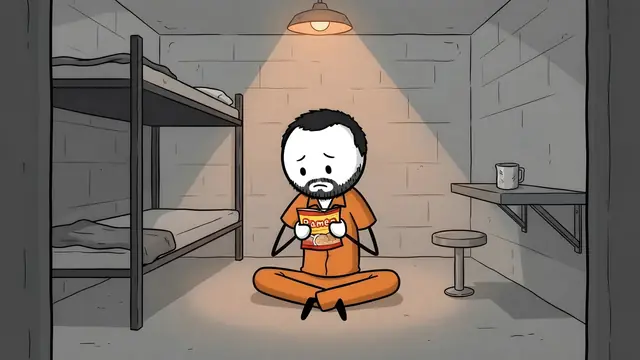
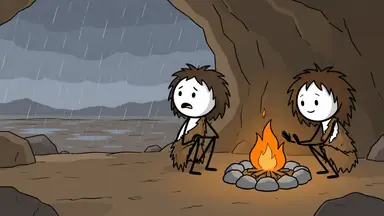
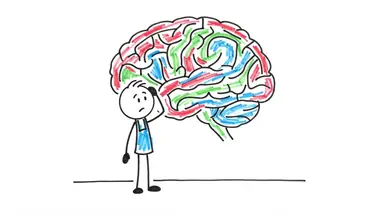
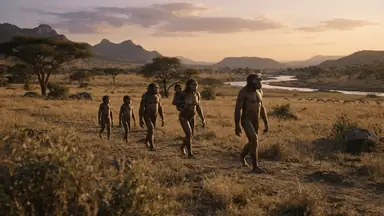
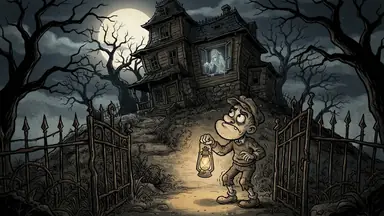
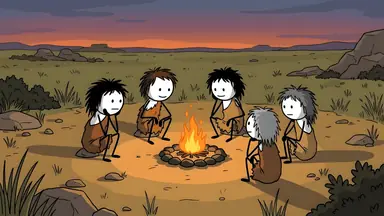
This 2:41 stick figure video was made with ClipFlux from one question about how early humans got through the night. ClipFlux wrote it in six chapters, from the endless dark to the price of darkness, narrated it and drew it in its Cartoon Stickman look with Fast cuts pacing, a new picture every few seconds. It is shown here unedited, including three lines that are wrong, which are pointed out below.
2:41, the whole video, unedited. Made with ClipFlux in the Cartoon Stickman look.
How it was made
| This video | |
|---|---|
| Started from | "What did ancient humans do at night?" |
| Look | Cartoon Stickman |
| Pacing | Fast cuts: a new picture every few seconds |
| Length | 2:41 |
| Chapters | 6, after a cold open |
| Scenes | 24 |
| Edited by hand | No |
What it gets wrong
- The opening says there was "no moon to guide the way". There always was a moon, and on clear nights it was the main light people had.
- It says there were "no fires yet". People were using fire hundreds of thousands of years before the cave and campfire life the rest of the video shows.
- It says lost sleep "left marks on the brain that lasted generations". Lost sleep is not passed on to children. Studies of hunter-gatherer groups today find they sleep about as long as people in industrial countries do (Yetish and others, Current Biology, 2015).
- None of these sounds wrong when narrated, which is the point: read an AI script before you post it. In ClipFlux any line can be sent back with a note and only that scene is made again.
Full transcript
0:00 Cold open
Before electricity, before cities, before anything we recognize as modern life, ancient humans faced a darkness we can barely imagine.
0:08 The Endless Dark
Every night, the sun vanished and took the world with it. There were no lamps, no fires yet, no moon to guide the way through the black. Predators hunted in that darkness, and Man could not see them coming. For hours after sunset, ancient humans endured the vulnerability of complete blindness, waiting for dawn.
0:25 Fire as Survival
But fire changed everything. A flame held back the dark. Man had learned to make it, to feed it, to keep it alive through the endless hours until dawn broke. Dry wood was precious. Grass, bark, bone, anything that would burn had to be gathered before darkness fell. The fire was not comfort. It was survival itself, the only thing standing between Man and the predators that hunted in darkness.
0:48 The Watchers
But fire alone could not protect them. Beyond the circle of light, predators waited and watched. Someone had to stay awake. Someone had to stand at the edge of the firelight and keep watch through the night. This was not a choice. It was a rotation, a burden shared. When one watcher grew tired, another rose to take their place. Every night, the same vigil began again. Every night, someone stood between the group and the dark.
1:13 Stories and Ritual
But as the watchers kept their vigil, the rest gathered close to the fire, and the night became something more than survival. One person would speak, and voices would rise in response, telling stories that had been told for generations, each retelling a thread binding the group together. Children learned the names of ancestors, the routes to water, the signs of danger, and the songs that held their world together, all woven into the night's telling. In the darkness beyond the fire, ritual and meaning took root, transforming the night from a time of fear into a time of belonging, knowledge, and the sacred bonds that made a people whole.
1:48 Sleep in Shifts
But sleep itself was a luxury they could not afford. Ancient humans slept in fragments, never deeply, always half awake. One person would stay awake while others rested, then they would switch. A few hours of light sleep, then a turn at watch. They huddled for warmth and safety, their bodies pressed close. In the cold and dark, isolation meant death. This was not rest as we know it. It was survival, measured in minutes of unconsciousness snatched between long hours of vigilance.
2:17 The Price of Darkness
But this vigilance came at a cost that shaped the human body itself. Sleep deprivation was not a choice but a way of life, and it left marks on the brain that lasted generations. Their nights bound them together, but they also bound them to fear, to constant tension, to a world that never truly felt safe. The night never left them, and it never leaves us. We are their children, still shaped by the darkness they could not escape.
Make a video like this
Type a topic, pick the Cartoon Stickman look and a narrator, and ClipFlux writes, draws and narrates it the same way. Start from this video's brief, or read more on the AI stickman video generator page.
More examples
- Could you survive a lifetime as a medieval peasant? (14:40, Doodle 2D)
- The Wall Street Crash, explained (3:27, Doodle 2D)
- The man who stole the Mona Lisa (3:30, Mannequin 3D)
- How the pyramids were actually built (4:03, PS2 Graphics)
- What is actually inside a fire hydrant? (2:46, Realistic)