










This 4:03 documentary was made with ClipFlux from six words: "How the pyramids were actually built". ClipFlux planned eight chapters, from the myth to what the evidence shows, narrated them and drew all 39 scenes in its PS2 Graphics look. It is shown here unedited, including two lines that are wrong, which are pointed out below.
4:03, the whole video, unedited. Made with ClipFlux in the PS2 Graphics look.
How it was made
| This video | |
|---|---|
| Started from | "How the pyramids were actually built" |
| Look | PS2 Graphics |
| Pacing | One picture per narration line |
| Length | 4:03 |
| Chapters | 8, after a cold open |
| Scenes | 39 |
| Edited by hand | No |
What it gets wrong
- It says modern scans revealed ramps spiralling up inside the pyramid. That is a hypothesis, proposed by the architect Jean-Pierre Houdin in 2007 and never confirmed. The 2017 ScanPyramids muon scans found a large void above the Grand Gallery whose purpose is unknown, not a ramp.
- It says Herodotus wrote fifteen centuries after the pyramids were built. He wrote around 450 BC, about two thousand years after the Great Pyramid, which dates to around 2560 BC.
- Neither sounds wrong when narrated, which is the point: read an AI script before you post it. In ClipFlux any scene can be sent back with a note and only that scene is made again.
Full transcript
0:00 Cold open
For 4,500 years, we thought we knew how the pyramids were built. We were wrong.
0:05 The myth we inherited
For centuries, we have imagined the pyramids built by endless rows of enslaved workers. Hollywood and history books showed us the same image: thousands of men hauling stone blocks with ropes. Whips cracked. Overseers shouted. Blocks weighing as much as trucks were dragged across sand by sheer human determination. This story was so powerful, so visually compelling, that it became the truth we all accepted without question.
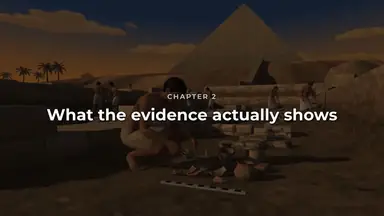
0:29 What the evidence actually shows
But archaeology has spent the last fifty years quietly dismantling this narrative. In the 1980s, excavators found an entire village built for workers, complete with bakeries and breweries. Skeletal remains show these workers were well-nourished, their bones strong and their injuries treated with care. Graffiti left by work gangs on the stones themselves reveals pride, organization, and something closer to employment than enslavement.
0:53 The engineering breakthrough
Yet the real puzzle remained unsolved: how did they move blocks weighing as much as thirty elephants upward? Modern scanning technology revealed what ancient texts never mentioned: internal ramps spiraled through the pyramid itself. These ramps wound through the structure itself, allowing workers to haul blocks incrementally without building massive external scaffolding. Chambers inside the pyramid weren't tombs or storage, but counterweights that redistributed force and reduced the load on each section.
1:20 The water-lubrication technique
But the ramps alone could not explain how blocks moved so swiftly across sand. Experiments in recent decades tested a radical hypothesis: what if workers simply wet the sand beneath the sledges? The results were astonishing. Friction dropped by nearly fifty percent. The sledge glided where it had stuck. This single innovation cascaded through the entire construction system, making the impossible suddenly achievable within a human lifetime.
1:45 The quarrying revolution
But water alone could not move stone from the earth. The quarries themselves demanded a revolution. Egyptian quarrymen did not hack randomly. They read the stone itself, following natural fault lines and grain. Copper chisels and wooden wedges were their tools. Precision, not brute force, separated the blocks. They cut grooves along all four sides, then drove wedges deeper until the block cracked free cleanly. A single block took weeks to extract. But once freed, it was already shaped to exact dimensions, ready for transport.
2:16 Logistics and organization
Moving a block from quarry to pyramid required far more than muscle. It demanded precision scheduling and supply chains. Teams rotated in shifts, each group responsible for specific tasks. Foremen tracked progress on papyrus records that still survive. Tool production was itself an industry. Copper chisels dulled quickly and had to be constantly replaced and resharpened. Supply lines stretched for miles. Bread, beer, and grain had to feed thousands daily. The pyramid was built on logistics as much as labor.
2:46 The real timeline
Those supply chains demanded coordination on a scale that required careful planning and strict scheduling. The Great Pyramid was not built in a single continuous push. It took approximately twenty years of sustained work. A rotating workforce of ten to fifteen thousand workers meant that no single person labored for the entire two decades. This was not slavery as Hollywood imagined it. It was organized, compensated labor with clear schedules and measurable progress.
3:12 Why we got it so wrong
Yet the image of whip-driven slaves persists in our collective memory. Herodotus, writing fifteen centuries after the pyramids, never visited a construction site. He relied on stories, rumors, and the assumptions of his own era about labor and power. Modern archaeology has dismantled this narrative piece by piece, through evidence, not imagination. Worker villages, tool marks, administrative records, and skeletal remains tell a different story entirely. The workers were fed, housed, and organized with the same precision that built the monuments themselves. We inherited a story from writers who never saw the evidence, and we believed it for centuries. The pyramids were built by organized, skilled workers who took pride in their labor and their nation. This is not a story of oppression. It is a story of human capability, organization, and will. The real story of the pyramids is far more remarkable than the myth we invented to explain them.
Make a video like this
Type a topic, pick the PS2 Graphics look and a narrator, and ClipFlux writes, draws and narrates it the same way. Start from this video's brief, or read more on the AI documentary video generator page.
More examples
- Could you survive a lifetime as a medieval peasant? (14:40, Doodle 2D)
- The Wall Street Crash, explained (3:27, Doodle 2D)
- The man who stole the Mona Lisa (3:30, Mannequin 3D)
- What is actually inside a fire hydrant? (2:46, Realistic)
- Ancient humans after dark (2:41, Cartoon Stickman)