





This 14:40 video was made with ClipFlux from a written brief: it follows "you", a peasant born in an English village in 1300, through childhood, the work of the year, the lord and the church, the Great Famine, marriage and the Black Death, to old age. ClipFlux wrote the script in 12 chapters, drew every scene in its Doodle 2D look with the same family throughout, and narrated it. It is shown here unedited, including three lines that are wrong, pointed out below.
14:40, the whole video, unedited. Made with ClipFlux in the Doodle 2D look.
How it was made
| This video | |
|---|---|
| Started from | A written brief (below) |
| Look | Doodle 2D |
| Pacing | Fast cuts: a new picture every few seconds |
| Length | 14:40 |
| Chapters | 12, after a cold open |
| Scenes | 174 |
| Edited by hand | No |
The full brief, as typed
Could you survive a lifetime as a medieval peasant? Follow "you" from your birth in an English village in 1300 to old age, speaking to the viewer as "you" the whole way through. The title question is the spine of the video: at every stage of life, show what could kill or ruin you, and whether you make it through. Open with a cold open that poses the question: a quick run of the dangers waiting for you (childhood illness, hunger, a failed harvest, an accident in the fields, the plague), a promise to find out whether you would make it, then go back to the day you are born. Then cover, in order: 1. Birth and your first years in a one-room cottage shared with animals, and why surviving childhood was the first test. 2. Learning the work of the year as a child: plowing, sowing, harvest, winter. 3. What you eat and drink, and what happens when a harvest fails. 4. The lord of the manor, the reeve, and the rent, labour and fines you owe. 5. The church, the priest and the tithe, and the feast days that break up the work. 6. The Great Famine of 1315 to 1317, when you are a teenager. 7. Marriage, a family of your own, and the dangers of childbirth. 8. Sickness, injuries and medieval medicine. 9. The Black Death arriving in 1348, when you are 48. 10. Growing old, if you get that far. End each chapter with a short survival check: did you make it, and what got you through. End the video by answering the title question honestly and comparing your life with the viewer's life today. Use concrete everyday details: smells, food, tools, weather, the work of each season. Keep every fact to well-known history and never invent statistics, percentages or exact numbers. No modern objects or clothing.
What it gets wrong
- It says your first winter comes before you are three months old, after a birth in March. A baby born in March is eight or nine months old by its first winter.
- It says well water could kill you, so even small children drank ale. That is a well-known myth, and the video later has you drinking from the well: people drank water from good wells and springs, and ale was everyday food and calories.
- It says childbirth "kills as many women as it saves". Childbirth was dangerous, but the best English estimates put deaths at roughly 1 to 2 percent of births, nowhere near half.
- None of these sounds wrong when narrated, which is the point: read an AI script before you post it. In ClipFlux any line can be sent back with a note and only that scene is made again.
Full transcript
0:00 Cold open
You are born into a world that wants you dead. Hunger, disease, accident, famine, plague. Can you survive a lifetime as a medieval peasant?
0:09 Born into the cottage
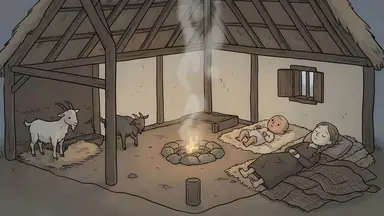
Your mother goes into labor on a cold morning in March, and there is nowhere to go but the cottage where you all live. The midwife has delivered babies in this village for forty years, but she has no tools but her hands and no medicine but prayer. Hours pass. Your mother screams. The animals shift and low in the corner, disturbed by the noise. Then, suddenly, you come. The midwife catches you, slick with blood and fluid, and you gasp your first breath. She cuts the cord with a knife, ties it with thread, and wraps you in cloth worn thin from a hundred births before yours. Your mother lies back, exhausted, and the midwife places you on her chest so you can find her breast and drink. If she can nurse you, you might live. If she cannot, you will starve within days. The cottage is cold. Smoke from the fire pit hangs in the air and stings your eyes and lungs. There is no window glass, no door that closes tight, and the wind finds every crack in the walls. The floor is packed earth, never cleaned, and the animals defecate where they stand, just feet away from where you lie. Infection is waiting. A scratch, a fever, a cough, and you could be dead before you are a week old. Your mother could die too. Bleeding will not stop, or fever will come, or her milk will fail. But you are born in a good year. The harvest was full, the stores are not yet empty, and your mother is strong. You drink her milk, and it keeps you alive through your first weeks. The fever does not come. The infection does not take hold. You have passed the first test. But half the children born in your village will not live to see their fifth birthday.
1:39 Your first winters
Your first winter arrives before you are three months old, and the cold is a killer. The cottage has no glass, no shutters, and the wind finds every crack in the walls. Your mother wraps you in cloth worn thin and holds you against the fire's heat day and night. But the fire is also a danger: children fall into it, and burns kill as surely as cold. You watch other children in the village cough through the dark months, their breath rattling. Fever comes first, then the cough that does not stop, then the child is gone. You are old enough to understand that some children do not see spring. Your mother knows this too, and she watches you for the first sign of sickness. She keeps you close to the fire, feeds you what milk she can, and prays. Winter lasts from November until April, and every week feels like a test you might fail. By the time you are three, you have survived two winters and seen five children from your village die. You do not remember their names, but you remember the fear, and you will carry it all your life. Survival check: you made it through your first winters, but only because your mother never left your side.
2:37 Learning the year's work
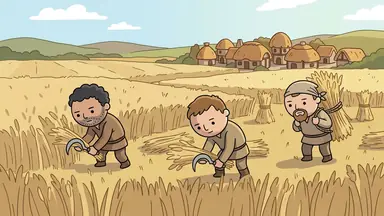
By six or seven years old, you are old enough to work. The fields call you now, and the year's rhythm becomes your own. Spring begins with plowing. Your father and the other men guide the plow through the heavy soil, breaking it open for seed. You learn to walk behind the plow, dropping seeds into the furrow. Your small hands are quick, but the work is endless. But the plow is dangerous. A slip, a stumble, and the blade can break your leg or worse. Summer brings weeding. You crawl between the growing plants, pulling out thistles and docks by hand, hour after hour in the heat. The heat is relentless. You drink from the stream when you can, but the water is often foul and makes you sick. Autumn is harvest, and it is the most dangerous season of all. Everyone works from dawn until dark, racing against the weather. You grip a sickle, a curved blade sharp enough to cut grain and sharp enough to cut you. Your hands bleed before the day is done. The heat exhausts you. Children collapse in the field, and sometimes they do not get up again. You learn to bind the cut grain into sheaves, tie them tight, and stack them to dry. Your back aches constantly. When the harvest is in, the grain is threshed. You beat the stalks with a flail to separate the grain from the chaff. The dust fills your lungs. You cough and cough, and the older workers laugh and tell you to keep working. Winter comes, and the work changes. You help thresh the remaining grain, repair tools, and gather firewood from the forest. The forest is cold and dark. You can get lost, or fall and break a bone, or meet a wolf or a wild boar. By the time you are ten or eleven, you know every task of the year. Spring, summer, autumn, winter: the cycle repeats, and you are part of it. You have survived the dangers of childhood work: the plow, the sickle, the heat, the cold, the dust, the forest. You are still alive. But survival is not the same as safety. The work will never stop, and neither will the dangers. You have learned the rhythm of your life.
4:30 What you eat and drink
Now you are old enough to understand what keeps you alive: bread, pottage, ale, and the fear of hunger. Bread is your life. Dark, heavy, made from rye or barley, sometimes mixed with beans to stretch it further. You eat it at every meal, morning and night, dipped in pottage or eaten plain with ale. Water from the well can kill you, so you drink ale instead, even children, even the very young. Meat is rare, a luxury for feast days or when an animal dies and must be eaten quickly before it spoils. Cheese and eggs come from the animals your family keeps, but most of what they produce goes to the lord. In spring and summer, you eat a little better: fresh greens, onions, peas from the garden when they ripen. But autumn harvest is when the granary fills, and you know you will eat through the winter ahead. The grain is measured and stored. Some goes to the lord as rent, some to the church as tithe, the rest is yours. But a bad harvest means the granary stays half empty, and you learn to fear the hunger that comes after. You have known hunger: the belly that aches, the bread rationed smaller each day, the pottage thinner and thinner. But you have not yet starved. You have made it through the lean winters, and the spring always brings new growth. You understand now that your life depends on grain, on the harvest, on the granary that stands between you and death.
5:50 The lord and the reeve
You own nothing. Not the cottage you sleep in, not the land you work, not even the tools in your hands. Everything belongs to the lord of the manor. He holds the title, the land, the law. But the lord does not come to your village. He sends the reeve, who collects what is owed. You owe him days of work on the lord's fields. Three days a week, sometimes more at harvest time. You also pay rent. Not in coin, which you do not have, but in grain and eggs and whatever else you can spare. And you pay fines. For cutting wood in the forest, for letting your pig stray, for anything the reeve decides is wrong. Your father knows this. He has paid fines all his life, and he pays them without complaint, because complaint changes nothing. But one day, the reeve comes to your cottage with a fine your father cannot pay. A large fine, for cutting wood without permission. Your father argues. He says the wood was fallen, already dead, not stolen from the lord's forest. The reeve does not listen. He writes in his ledger and tells your father the fine stands. Pay it, or lose land. You watch your father's face. You understand, for the first time, that you are not free. You are bound to this land and to the reeve's will. Survival means obedience. You pay what is owed, you work the days demanded, you stay invisible to authority. Those who resist, who speak out, who refuse to pay, lose everything. You will not be one of them.
7:10 The church and the priest
But the lord is not the only master who claims a share of what you grow. The priest demands a tithe, one tenth of every harvest, paid in grain. He is the only man in the village who can read, who knows Latin, who speaks to God. On Sundays you walk to Mass, and the priest preaches about sin and salvation. You confess your sins to him, and he absolves you, or he does not. Christmas comes, and the work stops for three days. Easter breaks the spring work, and saints' days scatter through the year. On those days you do not work, and you eat a little better than usual. The priest holds power over your soul, and your community gathers around him. But you resent the tithe, and you wonder if God truly demands so much. You survive by faith, by the community the church holds together, and by obeying what you cannot change.
7:55 The Great Famine
In the spring of thirteen fifteen, the rains begin and do not stop. By summer the grain has rotted in the ground, black and stinking. The harvest that year brings almost nothing, and the next year is worse. By winter, the stores are empty and the hunger begins in earnest. Your mother boils tree bark and roots to make a thin broth that fills your belly but not your hunger. You eat the family's pig, then the chickens, then the cow that should have pulled the plow. The lord still demands his rent, and the reeve still comes to collect it. Your father gives him grain he cannot spare, and you watch your family grow thinner. In the village, people begin to die, and you see things you will never forget. Some families eat the flesh of the dead, and some eat things that have no name. You do not know if your family will survive the next winter, or if you will. But in the spring of thirteen seventeen, the rains finally stop and the sun returns. Your family survives through desperation, through eating what no one should eat, and through luck. But you are changed forever by hunger, and you will never forget what you saw. Survival check: you made it through the Great Famine, but at a cost you will carry all your life. You are seventeen years old, and you have learned that survival is not certain, and that hunger is real.
9:05 Marriage and children
By your twenties, the famine is behind you, though hunger has left its mark. Your family arranges a marriage for you to a girl from the next village over. The priest blesses the union in the church, and you are bound for life. You move into a cottage with your wife, and the work of two becomes the work of one household. Within a year, your wife is pregnant, and you learn to fear what you cannot control. The midwife comes when the pains begin, and you wait outside, helpless. Hours pass. Then a cry, and the midwife calls you in to see your son. But joy is brief. Childbirth kills as many women as it saves, and you know it. Your wife recovers, but within two years she is pregnant again, and again you wait. Children come one after another, and each birth is a gamble you cannot refuse. By thirty, you have five children, and five mouths to feed means five times the work. Your eldest son learns to plow beside you, but your youngest daughter dies of a fever before her second winter. Not all your children will survive to adulthood, and you cannot know which ones will be taken. Your wife survives four more pregnancies, though each one leaves her weaker, thinner, more worn. You survive marriage and fatherhood, but the cost is written on your wife's face and in the graves of your children.
10:15 Sickness and injury
You are thirty-eight years old when the ladder breaks beneath your feet. Your left arm takes the full weight of the fall, and you hear the bone crack. Your wife binds it tight with strips of linen and sets it as straight as she can. It swells purple and black, and the pain keeps you awake for three nights. When the swelling fades, you find the arm will not straighten all the way. You learn to work one-handed, but plowing and reaping are harder now. Two years later, ague comes to the village, and you burn with fever for a week. Your neighbor Thomas goes to the barber-surgeon in the next village. The surgeon bleeds him to balance his humors, opening a vein in his arm. Three days later, Thomas is dead, the wound turned black and foul. You decide you will not see a physician, and you will not be bled. Instead you drink water from the well, eat bread when you can, and wait. The fever breaks on the eighth day, and you live, though you are weak for weeks. You see others who are not so lucky: old William goes blind, and Margaret loses her hearing. You survive your injuries and illnesses, scarred but alive, because you trusted time more than medicine.
11:16 The Black Death arrives
In the spring of thirteen forty-eight, a rumor reaches your village that turns your blood cold. Merchants from the south speak of a sickness spreading through the towns, killing faster than any plague before. People die in three days, they say, their bodies blackening before they are even cold. No one knows what brings it, or how to stop it, or whether it will reach here. But it does reach here, in the summer, when a family returns from the market town with fever. Within days, the swellings appear on their necks and under their arms, dark and weeping. Their fingers turn black as if burned, and the smell from their bodies is like nothing you have ever known. The priest comes to give them the last rites, but even he keeps his distance, his face wrapped in cloth. They are dead by the next morning, and the priest cannot dig the graves fast enough. More families sicken, and the deaths come so fast that bodies lie in cottages for days before burial. You see families you have known your whole life simply vanish, their cottages left empty and silent. Some people flee to the forest or to other villages, hoping to escape the sickness by running. But the sickness travels faster than any of them, and they carry it with them wherever they go. You stay in your cottage, alone, and you do not let anyone inside, no matter who they are. You eat what you have stored, drink from your own well, and pray that the sickness passes you by. The plague burns through the village for months, and then, slowly, the deaths begin to slow. By winter, the worst is over, but the village you knew is gone, and half the people are dead.
12:37 Growing old
You are sixty years old now, and your body is failing you. Your teeth are gone, worn down by a lifetime of grinding grain and grit. Your joints ache in the cold and damp, and your hands shake when you try to work. Your sight has dimmed so much that you cannot thread a needle or read the priest's lips. You cannot dig or plow or carry as you once did, and the reeve knows it. So the lord reduces your labor rent, but only because you are nearly useless to him. Your children are grown now, and they owe you nothing, but they feed you anyway. You sleep in the corner by the fire now, not in the loft with the rest. You remember the famine when you were young, and the plague that took half the village. You have buried more people than you have lived to see grow old. But you are still here, and that alone is a kind of miracle. Most children born in your village did not live to see their tenth year. You survived the hunger, the cold, the endless work, the sickness and the plague. You did not escape your village or your labor, but you lived. Survival check: you made it. Against the odds, you lived.
13:36 The answer
You made it. You lived sixty winters in a world that wanted you dead. Childhood illness could have taken you before you learned to walk. Hunger could have wasted you when the harvest failed and the stores ran empty. An accident in the fields could have crushed you under a plow or left you bleeding. The plague could have come for you at any moment, and it nearly did. But you did not die. You learned. You worked. You endured. You lost people. Your mother when you were young. Children who did not live to grow. You paid the lord his rent and the priest his tithe, year after year without choice. You had no doctor. When sickness came, you had herbs and prayer and hope. You had no choice in your life. You were born into the village and you died in it. Could you have survived? Yes. But only if luck held and your body stayed strong. Millions did survive. They lived and worked and died in villages like this one across all of England. Your life was not a story. It was work and survival and small moments of rest between the labor. You had no antibiotics, no safety net, no escape. You lived or you died, and most of the time you lived.
Make a video like this
Type a topic, pick the Doodle 2D look and a narrator, and ClipFlux writes, draws and narrates it the same way. Start from this video's brief, or read more on the AI long video generator page.
More examples
- The Wall Street Crash, explained (3:27, Doodle 2D)
- The man who stole the Mona Lisa (3:30, Mannequin 3D)
- How the pyramids were actually built (4:03, PS2 Graphics)
- What is actually inside a fire hydrant? (2:46, Realistic)
- Ancient humans after dark (2:41, Cartoon Stickman)